
Are you ready to transition from a skilled amateur into an elite, commercial image-maker? The Advanced Certificate in Photography at the Music and Film Academy is an industrial-grade training program engineered specifically for working photographers, media professionals, and content creators who already understand basic manual camera operation but need to master high-end studio lighting physics, advanced post-production, and commercial monetization. Located at Information House, Nairobi CBD, this specialized curriculum eliminates guesswork, teaching you to command light as a physical force and build a bulletproof freelance business in East Africa’s rapidly growing creative economy.
Succeeding at the highest tiers of fashion, editorial, corporate, and NGO media demands more than just a sharp eye—it requires absolute mastery over complex lighting geometry and high-end digital workflows. Earning an Advanced Certificate in Photography proves your technical authority to premium clients, agencies, and international organizations. Our advanced production spaces bridge the gap between creative intuition and high-ticket commercial execution, preparing you to lead complex multi-strobe sets and high-end editorial campaigns from day one.
Why Pursue an Advanced Photography Credential?
The commercial media market is highly competitive, and natural ambient light is often insufficient for high-ticket commercial assignments. Premium clients pay for predictability, consistency, and a distinctive visual signature that consumer equipment cannot produce on automatic modes.
Choosing the Advanced Certificate in Photography collapses your development timeline through intense, hands-on masterclasses:
- Absolute Lighting Authority: Move completely past ambient dependence by mastering studio strobe arrays, modifiers, and the mathematical laws of physical light degradation.
- High-End Digital Retouching: Learn magazine-grade, non-destructive editing workflows in Adobe Photoshop, including frequency separation and luminosity masking.
- Commercial Business Engineering: Calculate your exact cost of doing business (CODB), protect your intellectual property with local legal frameworks, and learn to command premium rates in the Kenyan corporate market.
If you are looking to build your baseline skills before tackling these complex commercial modules, you can review our foundational options or compare all our creative tracks by exploring our main hub page for photography courses in kenya.
📊 Program Overview & Fee Structure
This premium track is built around advanced competency modules, matching extensive studio runtime with professional-grade hardware and industry-standard business blueprints.
| Parameter | Specification |
| Course Duration | 2–3 Months (Advanced Masterclass Track) |
| Tuition Fees | KES 39,000 (Total Course Tuition) |
| Registration Fees | KES 2,000 (One-time) |
| Accreditation | TVETA Registered Framework |
| Campus Location | Information House, Nairobi CBD, Kenya |
💡 Explore More Creative Options: Looking to integrate high-end visual production with professional multi-camera video? Check out our visual arts directory to analyze our specialized photography courses alongside our extensive cinematography and audio production frameworks.
🗺️ Detailed Advanced Curriculum Structure
Our advanced curriculum focuses entirely on commercial-grade production competencies. Every module is highly detailed, uniquely structured, and designed to generate high-value assets for your professional portfolio.
Module 7: Advanced Lighting & The Inverse Square Law
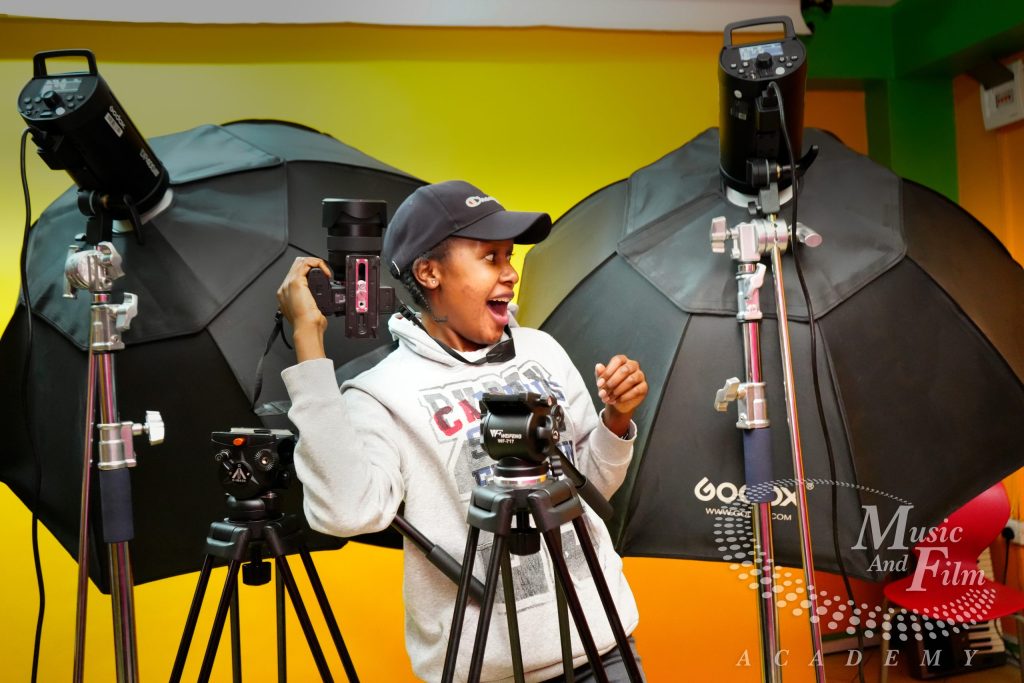
This module introduces off-camera flash and studio lighting using professional equipment available at our high-end campus facilities. Understanding artificial light opens doors to lucrative studio work, high-end event coverage, and premium commercial assignments.
- Constant vs. Strobe Lighting Physics: Analyze the technical boundaries dividing continuous illumination sources (such as high-output LED panels and tungsten arrays) from high-power studio strobes. Students learn how strobes deliver massive, instantaneous bursts of light that freeze rapid motion cleanly and overpower the harsh mid-day Nairobi sun during location shoots.
- The Inverse Square Law Mechanics: Master the mathematical formulas governing light fall-off (I = 1/d^2). Students learn why doubling the physical distance between a strobe and a subject reduces the light intensity to exactly one-quarter, utilizing this principle to create dramatic background drop-offs and control mood precisely.
- Flash Sync Speed & High-Speed Sync (HSS): Decode the mechanical limits of focal-plane camera shutters. Students examine standard native sync limits (typically 1/200s or 1/250s), learning how exceeding these boundaries produces destructive black bands across frames, and mastering HSS to shoot wide-open apertures under ambient light.
- Practical Exercise – “The Invisible Black Background”: Working in a brightly lit studio environment, students deploy a low native ISO, maximum native shutter speed, and close modifier placement to render ambient room light completely invisible, printing a pitch-black background without a physical backdrop.
Module 8: Portraiture & Human Connection
Portraiture forms the commercial backbone of many media careers, from high-end corporate headshots and weddings to editorial fashion spreads. Technical skills are vital, but establishing professional rapport determines whether final images feel alive or rigid.
- Deconstructing the Camera Mask: Developing specialized direction, psychological triggers, and communication patterns to guide subjects past defensive posing. Students learn to implement patient, clear physical adjustments to capture authentic expressions within the first few minutes of a session.
- Advanced Environmental Portraiture: Structuring complex visual narratives by framing subjects inside their native professional or personal contexts. Projects focus on lighting and capturing a barista inside a bustling CBD café, a session musician tracking inside the recording suites, or an artisan in their workshop.
- Foreshortening Principles & Geometry: Analyzing optical perspective distortion when body parts are placed closer to the lens element. Students master hand placement, shoulder angles, and precise facial tilt metrics to craft flattering, high-end corporate and fashion portraits.
- Practical Exercise – “The Stranger Project”: Students step into safe, public Nairobi environments to approach unfamiliar subjects, secure immediate legal verbal consent, build rapid rapport, and direct and execute three distinct emotional portraits within a strict 5-minute window.
Module 9: Documentary, Ethics, and The Narrative
Documentary photography and contemporary photojournalism require a deep blend of technical agility and rigorous ethical boundaries. This module prepares students to lead high-level NGO assignments, editorial features, and investigative visual storytelling across East Africa.
- The Structural Visual Story Arc: Mastering the five pillars of editorial narrative design: the Establishing Shot for environmental context, the Character Portrait for subject introduction, the Detail Shot for specific textural focus, the Interaction Shot capturing action, and the Closing Shot for narrative resolution.
- Ethical Image Making & Dignity Frameworks: Navigating the complex politics of representation. Students establish strict protocols to avoid exploitative imagery, protect the core dignity of vulnerable subjects, navigate public vs. private consent rules, and maintain absolute journalistic honesty during post-processing.
- Practical Exercise – “The 10-Frame Story”: Students document a local small business, independent craftsman, or cultural event, utilizing exactly 10 carefully planned, un-cropped frames to tell a compelling narrative with a defined beginning, middle, and end.
Module 10: High-Tech Specializations
Modern media branches into highly lucrative technical niches. This module helps students explore and master specialized photographic vectors that align with the region’s expanding real estate, advertising, and creative sectors.
- Night Logistics & Astrophotography: Commanding extreme low-light sensors and manual tracking setups. Students master The Rule of 500 (500 \ focal length = maximum exposure time before stars trail) and deploy advanced light-painting tools during long exposures.
- Architectural Engineering & Keystoning Correction: Correcting perspective lines and vertical tilt anomalies caused by wide-angle lenses in urban environments. Students learn spatial positioning strategies and shifting axis principles to deliver clean, plumb lines essential for the premium real estate market.
- Macro Photography & Focus Stacking: Navigating the physical limits of extreme close-up optics. Students learn to manage razor-thin depths of field, configure precise macro lighting rails, and deploy advanced software to stack multiple focus planes into a single sharp image.
- Practical Exercise – “City Lights”: Executing tripod-stabilized, 30-second long exposures of vehicle traffic across key Nairobi thoroughfares, creating clean light trails while maintaining tack-sharp architectural focus across surrounding buildings.
Module 11: High-End Retouching in Photoshop
Commercial, editorial, and beauty photography demand pristine, high-end final assets. This module delivers masterclass instruction in the industry-standard post-production workflows that separate professional commercial deliverables from amateur edits.
- Advanced Layer Architecture & Luminosity Masking: Mastering non-destructive editing pathways inside Adobe Photoshop. Students build intricate layer configurations, deploy advanced clipping paths, and utilize luminosity masks to target highlights and shadows surgically without bleeding across color channels.
- Surgical Frequency Separation: Master the industry standard for high-end skin and texture retouching. Students mathematically separate spatial frequency data into a High Layer (holding fine pore and fabric texture) and a Low Layer (holding underlying color, tone, and transitions), enabling flawless smoothing that retains natural skin texture.
- Three-Dimensional Dodge and Burn: Sculpting depth, specular highlights, and global shadows manually using curves and micro-brush exposures. Students learn to enhance the natural bone structure and dimensionality of portraits and commercial products without modifying original pixels.
- Practical Exercise – “The Commercial Edit”: Students take a raw studio portrait file through a comprehensive magazine-style retouching pipeline, executing blemish removal, precision frequency separation, fine hair cleaning, and structural color grading.
Module 12: Business, Branding, and Professional Ethics
Technical brilliance requires client acquisition to build a sustainable career. This module prepares students to launch and manage a legal, profitable freelance business or commercial studio practice within the East African media ecosystem.
- Curating the Portfolio via The Rule of 10: Mastering the art of editing down your archive. Students learn why a portfolio is only as strong as its weakest image, practicing strict curation to display exactly 10 world-class, cohesive images rather than massive, disorganized catalogs.
- Legal Protections & Copyright Management: Drafting enforceable contracts, commercial invoices, and usage rights. Students master the deployment of Model Releases and Property Releases, and explore local copyright registration steps to safeguard intellectual property.
- Calculating Cost of Doing Business (CODB): Breaking down the real math behind sustainable pricing. Students calculate overhead, software subscriptions, studio rent, marketing costs, and gear depreciation cycles to establish accurate day rates and project fees.
- “Killing Your Darlings” — The Art of Selection: Developing the critical objectivity required to discard personally favored files in favor of images that serve the client’s brief and the project’s core narrative.
🎓 Final Graduation Project: The Professional Monograph
To earn your Advanced Certificate in Photography, you must successfully defend a comprehensive, real-world capstone project before a panel of resident faculty and visiting media industry professionals.
- Core Portfolio Requirement: Compilation of a curated publication featuring 20 high-fidelity images bound by a cohesive thematic concept or distinct visual narrative (e.g., Nairobi Nightlife, or Artists Tracking at the Music and Film Academy).
- Unified Visual Signature: All 20 images must exhibit a consistent, intentional color-grading palette and stylistic harmony that proves your individual artistic voice.
- Technical Versatility Milestones: The final monograph must include at least one calculated long-exposure landscape, one fully studio-lit strobe portrait, and one raw, unposed candid documentary photograph.
- Metadata & Technical Transparency: Every included plate must be accompanied by full exposure metadata (Aperture, Shutter Speed, ISO, Focal Length) alongside a 100-word summary explaining the specific technical problem solved during acquisition.
- The Artist Statement: Submission of a professional, 500-word essay detailing your artistic philosophy, technical choices, and long-term commercial goals within the creative sector.
💼 Career Paths & Industry Opportunities
Graduating with an Advanced Certificate in Photography transforms your passion into a highly structured, monetizable asset. The contemporary media landscape in East Africa requires technical experts who understand data management, commercial lighting, and professional visual delivery.
Our graduates are equipped to step directly into high-value roles across several lucrative sectors:
1. Commercial & Advertising Photographer
- The Role: Crafting high-end visual campaigns for corporate brands, advertising agencies, and consumer goods companies across East Africa. You will lead professional production sets, manage multi-strobe configurations, and deliver polished product and editorial assets.
- Primary Industries: Advertising agencies, corporate marketing departments, manufacturing firms, and public relations agencies.
2. High-End Editorial & Fashion Photographer
- The Role: Collaborating with fashion designers, modeling agencies, and lifestyle magazines to produce striking, concept-driven visual spreads. This path heavily relies on your mastery of frequency separation, skin retouching, and advanced studio modifier physics.
- Primary Industries: Fashion houses, digital and print publications, model management firms, and premium portrait studios.
3. Documentary & NGO Photojournalist
- The Role: Partnering with international organizations, local non-profits, and humanitarian agencies to document development projects, human rights initiatives, and community stories. Your training in visual story arcs and ethical dignity frameworks prepares you directly for this highly impactful field.
- Primary Industries: International and regional NGOs, civil society organizations, environmental advocacy groups, and global news agencies.
4. Real Estate & Architectural Photographer
- The Role: Capturing high-end commercial properties, residential developments, and architectural landmarks for premium listings. Using your technical knowledge of keystoning correction and perspective control, you will deliver clean, plumb-line assets that drive sales.
- Primary Industries: Real estate agencies, interior design firms, hospitality groups, and property development companies.
5. Professional Commercial Retoucher
- The Role: Working behind the scenes as a specialized digital artist. If you prefer the post-production engine, you can build a career strictly executing magazine-grade editing, advanced color grading, dodge-and-burn sculpting, and complex compositing for other photographers and agencies.
- Primary Industries: Production houses, global freelancing networks, creative agencies, and high-volume e-commerce platforms.
❓ Frequently Asked Questions
What are the prerequisites for the Advanced Certificate in Photography?
Applicants should ideally hold a basic Certificate in Photography or pass a practical portfolio review demonstrating a clear understanding of manual exposure controls, the exposure triangle, and basic image editing. If you can confidently shoot in complete manual mode and want to master studio strobes and high-end editing, this course is designed for you.
What equipment do I need for this advanced course?
The Academy provide access to high-end studio strobe arrays, modifiers, triggers, and continuous lighting rigs during your practical lab sessions. While owning a professional DSLR or Mirrorless camera with a hot-shoe flash connection is highly recommended for personal field assignments, students can reserve campus hardware for their core coursework tracking.
Does this course cover commercial business structures for Kenya?
Yes. Module 12 focuses extensively on the local creative economy, legal copyright tracking, corporate pricing structures, contract drafting, and managing commercial billing within the East African market.