
Are you ready to step away from automatic camera modes and start producing broadcast-quality digital video assets? The Basic Certificate in Videography at the Music and Film Academy is a technically intensive program engineered specifically to transform beginners, content creators, and corporate media enthusiasts into highly competent, industry-ready camera operators and video editors. Located in the heart of the Nairobi CBD at Information House, this foundational track concentrates heavily on the technical “Science of Capturing”. Students are systematically stripped of automated dependencies, gaining absolute manual command over video exposure mechanics, multi-source continuous lighting physics, and field audio acquisition.
Entering today’s media landscape requires structured, competency-based skills rather than guesswork. Earning a Basic Certificate in Videography provides the essential technical foundation needed to capture pristine footage that stands out in commercial markets. Training occurs under a strict 1:1 student-to-gear ratio within our specialized Nairobi media labs, ensuring you spend maximum time with professional production rigs rather than just watching a screen. Whether you want to film commercial events, launch high-end social media channels, or build a foundation for cinema post-production, this course prepares you to step confidently onto any professional set.
Why Choose a Foundational Video Production Track?
While modern camera systems boast incredible automated tracking, they cannot make creative or technical calculations for complex lighting and narrative pace. A structured, hands-on program helps you master the underlying physics of digital sensors and lens optics so you can deliver predictable results under any shooting conditions.
By focusing on the core mechanics of visual grammar, field audio signal flow, and non-linear editing workspaces, you gain a versatile skill set that can be instantly monetized. If you are looking to compare various academic levels, duration frameworks, or advanced cinematic specialization options, you can review our full visual arts directory on our main hub page for videography courses in kenya to see how our different training modules map to your career trajectory.
📊 Program Overview & Fee Structure
This foundational track is optimized for flexible, hands-on competency training, allowing working professionals and students to learn at a professional pace.
| Parameter | Specification |
| Course Duration | 2-3 Months (Intensive, Part-Time Study Mode) |
| Tuition Fees | KES 39,000 (Total Course Tuition) |
| Registration Fees | KES 2,000 (One-time institutional fee) |
| Timing & Flexibility | Weekdays with Flexible Shift Schedules |
| Core Systems & Software | 4K Mirrorless/DSLR Rigs, Field Audio, Adobe Premiere Pro, DaVinci Resolve |
| Campus Location | Information House, Nairobi CBD, Kenya |
💡 Explore Your Academic Paths: Looking to see how this foundational track nests into our wider visual arts department? You can cross-reference our entry-level modules with short-form workshops and technical options directly on our videography courses in Kenya category hub page.
🗺️ Fresh & Unique Curriculum Structure
Module 1: Sensor Mechanics & Manual Camera Operations
This opening module dismantles computational dependencies, training the eye and hand to regulate light exposure through direct hardware manipulation.
- The Exposure Math Matrix: Demystifying how sensor sensitivity, electronic gain, and internal physical shutter blades dictate raw signal clarity. You will configure manual balance baselines to record clean, high-definition digital streams under unforgiving low-light environments without introducing digital grain or compression noise.
- The 180-Degree Shutter Protocol: Calculating the strict mathematical alignment between project frame rates and operational shutter speeds. Students practice locking workflows to exactly 1/48s at 24fps and 1/100s at 50fps, developing an intimate understanding of how shutter timing impacts human psychological perception of motion blur.
- Optics & Imaging Geometries: Deep technical analysis comparing image sensor form factors, from expansive Full-Frame glass paths down to compact APS-C and Micro Four Thirds standard layouts.
- Focal Field Calculations: Working out real-world crop-factor math to predict field-of-view translation across different lenses, alongside a technical review of spherical lens designs versus anamorphic framing structures.
Module 2: Spatial Layouts & The Language of Composition
Moving past standard snapshots, this section treats the camera viewfinder as a dynamic canvas governed by geometric rules and psychological patterns.
- Geometric Framing Paradigms: Engineering visual balance across moving elements by superimposing structural grid guides—such as the Rule of Thirds, the Golden Ratio proportions, and active dynamic symmetry matrices—directly onto viewfinders.
- The Scale-Emotion Pipeline: Deploying intentional shot sizes to control audience focus and story tension. We study how tight macro details draw out intense focus while sweeping global establishing masters anchor a scene’s physical environment.
- Axis Angles & Psychological Stature: Exploring perspective adjustments to shift character power dynamics, mapping out how low-angle camera setups project strength and high-angle placements signal isolation or vulnerability.
Module 3: Continuous Light Engineering & Color Physics
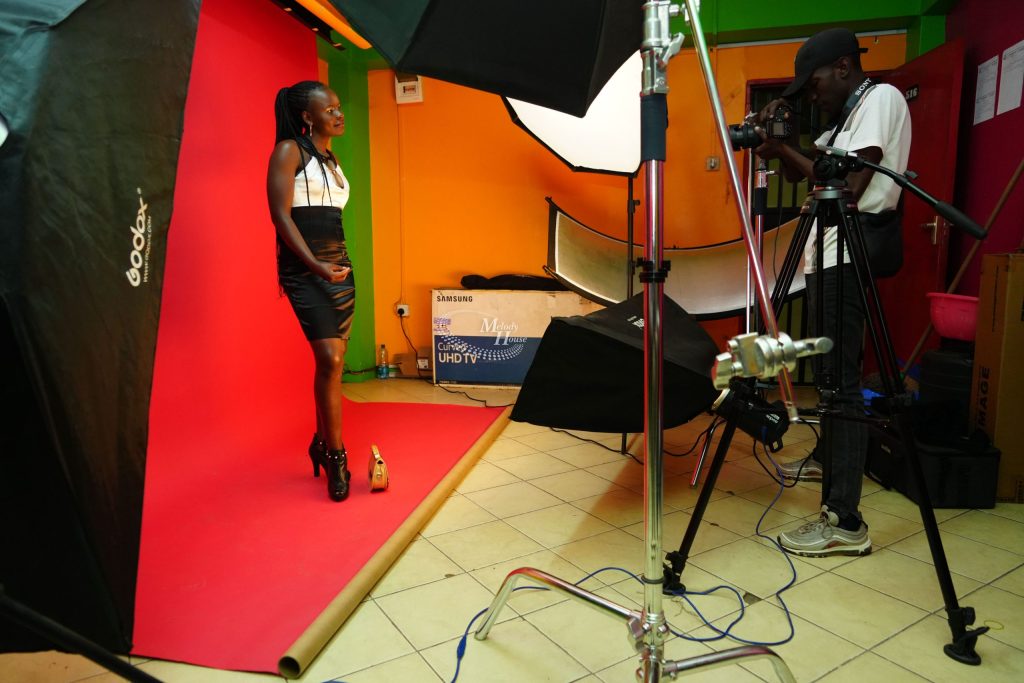
Students step into the physics of artificial lighting, learning how to manipulate continuous arrays to build dimension and balance environmental color shifts.
- Three-Point Modeling Foundations: Building depth on flat surfaces using commercial continuous arrays. You will manually position a principal Key light for structural texture, apply a secondary Fill array to balance contrast ratios, and drop a Backlight behind the subject to create separation from studio backdrops.
- Light Degradation Mechanics: Applying the absolute laws of light dissipation over physical distance (I = P/4pi r^2). Students manipulate fall-off distance parameters to intentionally darken backgrounds and shape professional cinematic atmospheres in standard spaces.
- Thermodynamic Kelvin Management: Mastering the color spectrum of light across environmental environments. Students override automated sensor white balance routines to match color fields manually, moving seamlessly between warm indoor incandescent properties (3200K) and cool, standardized outdoor daylight matrices (5600K).
Module 4: Location Audio & Signal-to-Noise Engineering
This module details how to capture clear dialogue and pristine location soundscapes, treating field audio as an equal partner to the visual frame.
- Acoustic Transducers & Capture Fields: Mapping out the spatial pickup shapes and directional borders of professional field microphones, focusing on highly focused hyper-cardioid shotgun tubes, cardioid vocal capsules, and omnidirectional lapel setups.
- Impedance matching & Gain Architecture: Navigating balanced hardware lines against unbalanced consumer cabling systems. Students learn to calibrate multi-stage gain systems, establishing the core electrical separation between Mic and Line impedance inputs to prevent signal clipping.
- Lavalier & Boom Pole Placement Labs: Practical field engineering workshops tracking how to cleanly hide wireless lapel rigs inside wardrobe arrays and navigate overhead boom poles right at the edge of the lens frame without dipping into the shot.
Module 5: Non-Linear Post-Production & Timeline Architecture
The final module transitions raw field production assets into structured, beautifully paced final timelines using professional editing suites.
- NLE Cataloging & Asset Engineering: Configuring pristine project directories, file tree hierarchies, scratch disk paths, and media ingestion templates inside Adobe Premiere Pro and DaVinci Resolve to establish a fast, efficient workflow.
- The Narrative Cut Execution: Analyzing the structural psychology of an edit. Students master temporal continuity and rhythm using clean straight cuts, overlapping J-cuts and L-cuts, spatial match cuts, and paced cross-fades to regulate narrative movement.
- Compression Packaging & Master Delivery: Exporting final timeline tracks into optimized compression profiles; configuring professional wrappers—including light H.264/MP4 files for immediate web distribution and heavy Apple ProRes or DNxHR containers for television broadcast distribution channels.
💼 Career Paths & Industry Opportunities
Graduating with a Basic Certificate in Videography provides you with versatile, foundational skills that are highly valued across modern digital and corporate sectors.
Our graduates are technically prepared to enter the workforce in several entry-level and freelance paths:
1. Camera Assistant & Grip
- The Role: Assisting lead cinematographers on commercial production sets, television shoots, and music videos. You will handle manual exposure checks, set up continuous 3-point lighting arrays, manage camera rigs, and support the tracking team.
- Primary Industries: Film production companies, commercial advertising agencies, and local broadcast stations.
2. Digital Video Editor (Junior)
- The Role: Organizing project assets, managing ingestion pipelines, and cutting raw footage into clean sequences using Adobe Premiere Pro or DaVinci Resolve. You will execute seamless pacing transitions, L-cuts, and J-cuts for client reviews.
- Primary Industries: Post-production houses, corporate marketing teams, and YouTube content channels.
3. Corporate Social Media Content Creator
- The Role: Filming and editing high-impact, short-form video assets optimized specifically for digital platforms and corporate marketing channels. Your understanding of framing geometry, manual exposure, and clean audio routing guarantees professional brand presentation.
- Primary Industries: E-commerce businesses, digital marketing agencies, PR firms, and startups.
4. Independent Event Videographer
- The Role: Launching your own freelance business covering local corporate events, product launches, panel discussions, and lifestyle celebrations. Your ability to set up field audio, manage wireless lavaliers, and deliver web-optimized H.264 files makes you highly competitive.
- Primary Industries: Direct-to-consumer event services, corporate communications, and independent digital production.
❓ Frequently Asked Questions
What are the entry requirements for this basic videography course?
Because this foundational Basic Certificate in Videography is an intensive skill-acquisition track tailored for beginners, we prioritize creative potential and aptitude over past grades. There are no strict KCSE mean grade cut-offs. Basic computer literacy and a strong drive to learn media technologies are all that are required to apply.
Do I need to buy my own camera or editing laptop before joining?
No. The Music and Film Academy labs are fully equipped with 4K mirrorless production rigs, field audio equipment, continuous lighting fixtures, and dedicated editing workstations loaded with Adobe Premiere Pro and DaVinci Resolve. You will have dedicated access to our gear during scheduled labs under our 1:1 student-to-gear framework.
Can I transition into advanced cinematography or film post-production later?
Yes, absolutely. This curriculum builds a clean, non-automated foundation that perfectly positions you for advanced cinematic specializations, commercial lighting masterclasses, or high-end color grading programs.